The BiblioNest. Curate your collection, your way.
© 2026 Ann Mathenge · Built with love, coffee, and cat hair.

Loading...

Dynamics of Learning in Early Modern Italy
Ethics as philology
Forms of Conflict and Rivalries in Renaissance Europe
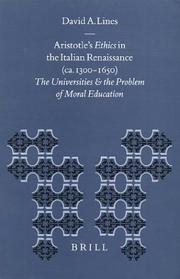
Management and Resolution of Conflict and Rivalries in Renaissance Europe
Fables and Fairy Tales
The commentary literature on Aristotle's Nicomachean Ethics in early Renaissance Italy
University natural philosophy in Renaissance Italy
Sources and authorities for moral philosophy inthe Italian Renaissance
© 2026 Ann Mathenge · Built with love, coffee, and cat hair.



By David A. Lines, Sabrina Ebbersmeyer
Moral philosophy, and particularly ethics, was among the most contested disciplines in the Renaissance, as philosophers, theologians, and literary scholars all laid claim to it, while an expanding canon of sources made the ground shift under their feet. In this volume, eleven specialists drawn from literature, intellectual history, philosophy, and religious studies examine the configuration of ethics and how it changed in the period from Petrarch to Descartes. They show that the contexts in which ethics was explored, the approaches taken to it, and the conclusions it reached make Renaissance ethics something worthy of exploration in its own right, in distinction to both medieval and early modern ethics. Particular attention is given to the development of new audiences, settings, genres, and mediums in ethical discussions, as well as the continuities with the formal exploration of ethics through commentaries. Renaissance ethics emerges as a highly eclectic product, which combined Christian insights with the Aristotelian and Platonic traditions while increasingly incorporating elements from Stoicism and Epicureanism. This volume will be of particular interest to students and researchers who wish to gain an overall view of how ethics developed throughout Europe in response to the cultural, historical, and religious changes between 1350 and 1650. --from back cover.
Published
2013
Format
-
Pages
351
Language
English
ISBN
9782503525242