
The BiblioNest. Curate your collection, your way.
© 2026 Ann Mathenge · Built with love, coffee, and cat hair.

Loading...


Enterprise government
Performance Measurement and Performance Management. International Journal of Productivity and Performance Management, Volume 54, Issue 7
International Journal of Productivity and Performance Management : Accountability and Organisational Performance in the Public Sector
International Journal of Productivity and Performance Management, 60
© 2026 Ann Mathenge · Built with love, coffee, and cat hair.



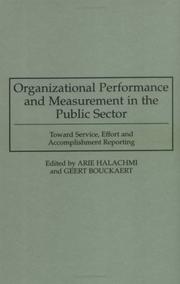
By Arie Halachmi, Geert Bouckaert
The end of the Cold War, advances in information technology, and the many other global changes of the past decade have required managers to change their frame of reference. It is increasingly clear that, for management at all levels, the twenty-first century is going to be greatly different from present and past experience in governance and public administration.
These profound changes will add completely new dimensions to the enduring challenges public managers continually face, involving accountability, democratic values, and productivity and efficiency.
This timely book, sponsored by the International Institute of Administrative Sciences, brings together leading authorities from the United States and around the world to address the most critical issues facing the public sector today - how to reorganize, reengineer, revitalize, modernize, and innovate in government and how to adapt to an everchanging global political environment.
In fifteen thoughtful chapters written especially for this book, respected scholars in the field of public administration discuss the challenges to productivity posed by the immediate and distant changes in our economic, political, and administrative environment.
The authors examine the issues that shape the image of agencies for those working inside, as well as those working outside, looking at how organizations can overcome damaging public perceptions of incompetence and slow-moving bureaucracy and how they can face the challenge of the inevitable bureaucratic red tape.
The book also addresses an array of public management approaches such as total quality management, reengineering, and more. Contributors discuss, for instance, how executives can use new information technology to improve public services, enhance agency productivity and evaluate the benefits and challenge of using volunteers.
The authors look at how strategic planning can help public agencies to develop a shared vision around mission, goals, resources, power, and authority, and tell how strategy maps can help implement strategic management. And they explain how agencies can accurately measure productivity and performance.
Published
1995
Format
-
Pages
467
Language
English
ISBN
0787900672